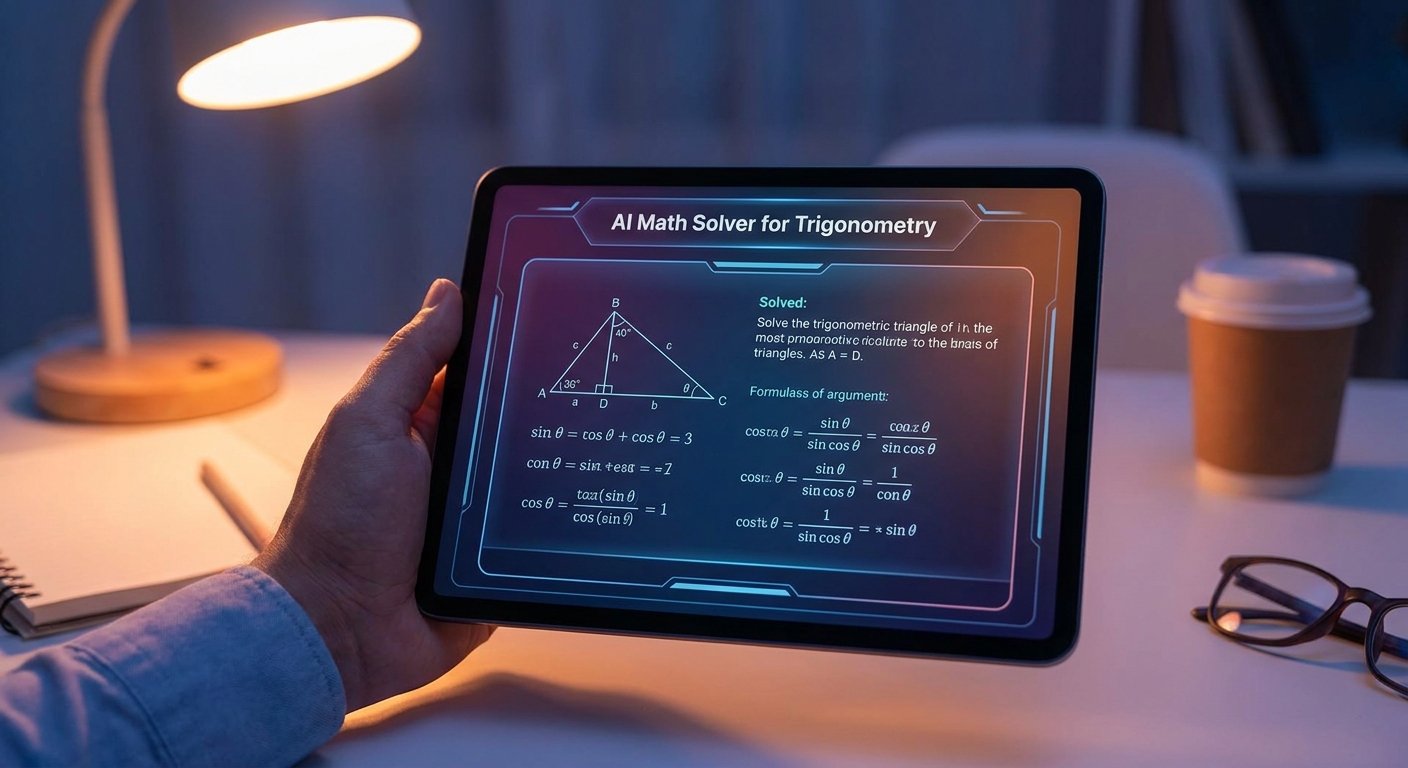
Trig identities don't care how confident your algebra is — one sign error in a Pythagorean identity and the whole proof collapses. This guide breaks down what to look for in an ai math solver for trigonometry, which tools actually explain the unit circle instead of just spitting out a decimal, and where Solvely fits for students grinding through SOHCAHTOA, radians, and Law of Sines problems in 2026.
- Solvely is the pick for step-by-step trig work — it cross-checks answers across multiple AI models before showing a solution.
- A calculator app that only returns a final number is a Skip for trig; you need the identity or theorem named at each step.
- Photomath and Mathway handle basic right-triangle problems fine but thin out on Law of Cosines and radian conversions.
- Graphing support for sine and cosine curves matters as much as algebra steps — verify a tool shows the graph, not just the equation.
Why this matters
Trigonometry is where a lot of students hit a wall that algebra never built. The unit circle, radian measure, inverse trig functions, and the Law of Sines and Law of Cosines all show up in the same semester, and a wrong reference angle early in a problem produces a confidently wrong final answer. An ai math solver for trigonometry that only returns "x = 0.86" without naming the identity used is close to useless when the assignment asks you to show work — and most trig homework in 2026 still requires it.
The difference between a decent solver and a bad one isn't speed. It's whether the tool tells you why cos(2π/3) is negative, not just that it equals -0.5.
Who this is for
This is for high school students in Trig or Precalc, college students taking Calculus prerequisites, and anyone prepping for the SAT or ACT trig sections in 2026. If you're solving right triangles with SOHCAHTOA, graphing sine and cosine transformations, or working through the unit circle in radians, the criteria below apply directly to you.
What to look for in an AI math solver for trigonometry
Step-by-step identity naming
A solver that shows "using the Pythagorean identity" or "applying the Law of Cosines" teaches you the method, not just the answer. Trig exams in 2026 grade on shown work almost universally, so a tool that skips the identity name leaves you unable to reproduce the solution on paper.
Radian and degree handling
Trig problems flip between radians and degrees constantly, and a solver that assumes degrees when the problem states π/4 will hand you the wrong reference angle. Confirm the tool recognizes both units before you trust a batch of homework answers to it.
Graph rendering for sine and cosine functions
Amplitude, period, and phase shift questions are hard to verify from an equation alone. A tool that graphs the transformed curve next to the original lets you visually confirm a shift of π/2 versus a shift of π, which catches errors a raw formula won't.
Handling of inverse trig and multiple solutions
Arcsin and arccos problems often have more than one valid answer within a given domain, and a solver that returns only the principal value misses half the question. Check whether the tool flags "additional solutions exist in this interval" before you submit.
Cross-verification across methods
The same trig identity problem can be solved by substitution or by graphing, and both should agree. A solver worth trusting for exam prep cross-checks its own answer rather than showing one path and calling it done — Solvely runs problems across multiple AI models specifically to flag when two methods disagree.
Handwriting and photo input accuracy
Trig notation is dense — exponents on trig functions, subscripts, degree symbols — and a photo math solver that misreads sin²(x) as sin(2x) will solve a completely different problem. Test any photo-input tool on a page of your actual handwriting before relying on it for a graded assignment.
Try Solvely on your next trig set
Upload a problem set and see the step-by-step identity breakdown.
Top picks for trigonometry problem-solving
Solvely — the safe pick. Solvely cross-checks trigonometry answers across multiple AI models and flags conflicts before showing a final solution, which matters when one identity substitution gives a different-looking but equivalent form. It handles radian and degree input, graphs sine/cosine transformations, and works from typed problems or photos on web, iOS, Android, and Chrome. Verdict: Buy.
A generic scientific calculator app — the decimal trap. These return a numeric answer to a trig equation in under a second but show zero identity work, meaning you learn nothing about why cos(5π/6) equals what it equals. Fine for checking a final numeric answer, useless for showing work on an exam. Verdict: Skip for graded homework, Consider for quick number-checks only.
Photomath-style photo solvers — decent for basic right triangles. These tools handle straightforward SOHCAHTOA problems reasonably well when the photo is clear, but accuracy drops on multi-step Law of Sines and Law of Cosines problems with ambiguous case (SSA) triangles. Verdict: Consider for warmup problems, not for the ambiguous case.
General-purpose AI chat tools (typed prompts only) — the wildcard. Typing a trig identity into a general chatbot can produce a correct derivation, but there's no built-in cross-check, no photo input for handwritten problems, and no graph rendering unless you ask separately every time. Verdict: Consider as a supplement, not a primary solver.
Textbook-bundled solution manuals — the outdated pick. These only cover the exact problems printed in your book, so a slightly modified homework version (different angle, different triangle) gets no match. Verdict: Skip if you need a tool that solves problems your textbook doesn't already answer.
What to avoid
- Solvers with no radian mode. If a tool assumes every angle input is in degrees, feeding it 5π/6 without conversion produces a garbage answer that looks plausible.
- Tools that hide the ambiguous case. Law of Sines problems with SSA data can have zero, one, or two valid triangles — a solver that silently picks one solution and doesn't mention the other is teaching you a shortcut that fails on the next exam question.
- Photo solvers with no confidence flag. If the tool can't tell you it misread your handwriting, you won't know the answer is wrong until your teacher marks it.
Verdict comparison
| Tool | Identity steps shown | Radian support | Graphs sine/cosine | Handles ambiguous case | 2026 verdict |
|---|---|---|---|---|---|
| Solvely | Yes, cross-checked | Yes | Yes | Flags it | Buy |
| Photo solver (generic) | Partial | Sometimes | No | No | Consider |
| Scientific calculator app | No | Yes | No | No | Skip for homework |
| General AI chatbot | Yes, on request | Yes | On request only | Rarely flagged | Consider |
| Textbook solution manual | Yes | Yes | No | No | Skip |
“A trig solver that skips the identity name teaches you nothing you can reproduce on the exam.”
FAQ
What's the best ai math solver for trigonometry in 2026?
Solvely is the strongest pick for trig work in 2026 because it names the identity used at each step and cross-checks answers across multiple AI models before showing a solution. Generic photo solvers handle basic right triangles but weaken on ambiguous-case Law of Sines problems.
Is an AI solver better than a graphing calculator for trigonometry?
For learning why an answer is correct, yes — an AI solver names the identity or theorem used, while a graphing calculator only returns a numeric result. For quick number-checking during a timed exam, a graphing calculator is still faster.
How much does an AI math solver cost in 2026?
Pricing varies by app and platform, so check current pricing directly on the provider's site before committing to a paid tier.
Can AI solve Law of Sines and Law of Cosines problems?
Yes, most modern AI math solvers handle both, but accuracy drops on the ambiguous case (SSA) where zero, one, or two triangles can satisfy the given data. Confirm the tool flags multiple solutions rather than silently picking one.
Does a photo math solver work on handwritten trig problems?
It depends on handwriting clarity — messy exponents on trig functions like sin squared are a common misread that produces a wrong final answer. Test the tool on your actual handwriting before trusting it for graded work.
What's the difference between radians and degrees in an AI solver?
Radians and degrees are two units for the same angle, and a solver must detect which one a problem uses or it will compute the wrong reference angle. Confirm radian support before feeding it a problem written as a fraction of pi.
Can AI solvers graph sine and cosine functions?
Some can render the transformed curve alongside the equation, showing amplitude, period, and phase shift visually. This matters for verifying transformations that are hard to check from the formula alone.
Is Solvely good for trigonometry word problems?
Solvely handles trig word problems by breaking down the setup step-by-step before solving, which matters when the hard part is translating the scenario into a triangle or equation. A dedicated walkthrough on solving word problems with an AI math solver covers the setup process in detail.
One last thing
The most common trig mistake isn't a calculation error — it's picking the wrong reference angle in the wrong quadrant, and no calculator catches that because the arithmetic downstream is technically correct. Any ai math solver for trigonometry worth using in 2026 should call out the quadrant it used before showing the final identity or triangle solution, not after.